
Back to AQA Simultaneous Equations (H) Home
2.4 C) Linear Simultaneous Equations: Substitution Method
2.4 C) Linear Simultaneous Equations: Substitution Method
The substitution method is mainly used for simultaneous equations that contain quadratic terms (we be looking at quadratic simultaneous equations later on in this section), but it can still be used for the linear simultaneous equations (linear equations are where the highest power of x is 1; x to the power of 1 is just x).
The substitution method works by finding a value for one of the unknowns in terms of the other unknown. We do this by making one of the unknowns the subject in one of the equations. We then sub in the expression that we have found for the unknown that we have made the subject into the other equation. By doing this, we get rid of one of the unknowns in the equation leaving just one unknown, thus meaning that we can solve the equation to find the unknown that is left.
The substitution method works by finding a value for one of the unknowns in terms of the other unknown. We do this by making one of the unknowns the subject in one of the equations. We then sub in the expression that we have found for the unknown that we have made the subject into the other equation. By doing this, we get rid of one of the unknowns in the equation leaving just one unknown, thus meaning that we can solve the equation to find the unknown that is left.
Example 1
Use the substitution method to solve the simultaneous equation below.
Use the substitution method to solve the simultaneous equation below.
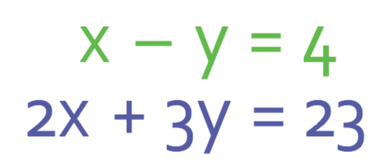
Let’s make x the subject in the first equation that we are given.

We make x the subject by moving the -y from the left side of the equation to the right. We are able to do this by doing the opposite of taking y, which is adding y. Therefore, we add y to both sides of the equation.
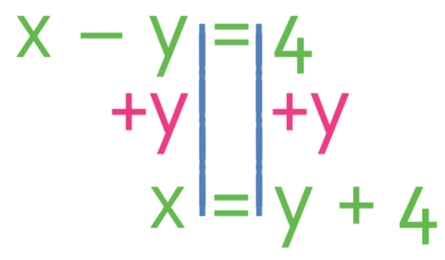
We now substitute our expression for x into the second equation. This gives us:
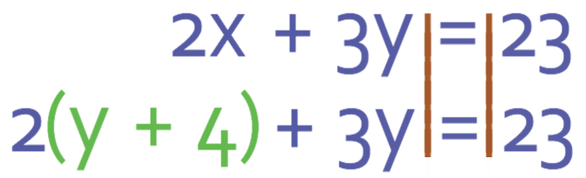
The next step is to expand the brackets.
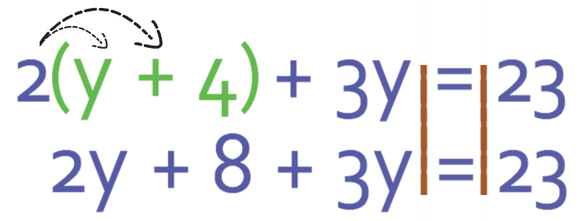
We now have an equation with one unknown (y). This means that we can solve in the usual way. The first step in solving this equation is to collect like terms; we collect the y’s on the left side of the equation.
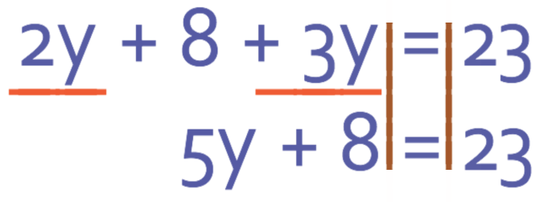
We then move the 8 from the left side of the equation to the right. We are able to do this by doing the opposite; we take 8 from both sides of the equation.
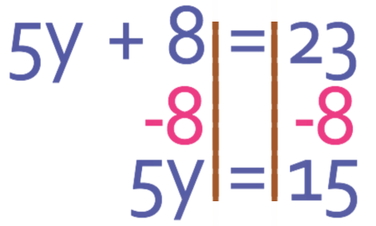
We want to find the value of y and not 5y. Therefore, we divide both sides of the equation by 5.
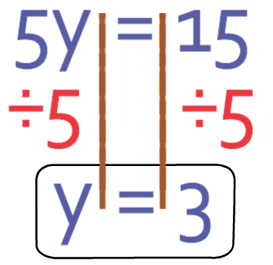
This tells us that y is 3.
Now that we have found the value for y, we can sub the value that we have found into either of the equations. Let’s use the first equation.
Now that we have found the value for y, we can sub the value that we have found into either of the equations. Let’s use the first equation.
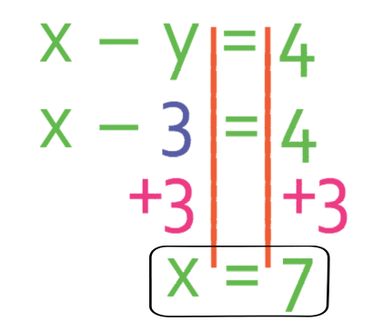
To check that we have the correct answer, we can sub the values that we have found for x and y into the second equation; we sub x in as 7 and y in as 3.
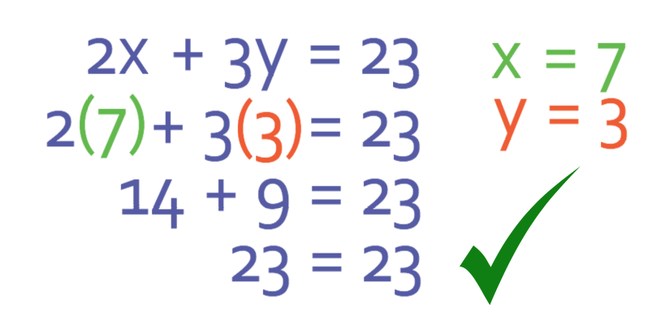
The equation works, which means that we have found the correct values for x and y; x is 7 and y is 3.
Example 2
Use the substitution method to find the value of a and b.
Use the substitution method to find the value of a and b.
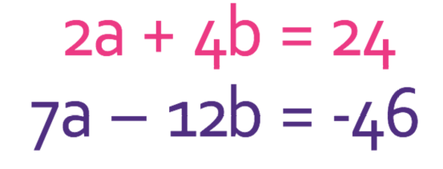
The first step in answering this question is to make one of the unknowns the subject in either of the equations; it does not matter which unknown we make the subject and it does not matter which equation we use. I am going to make a the subject in the first equation.

In order to make a the subject, we need to get all of the a’s to one side and everything else to the other side. I am going to get all of the a’s to the left and everything else to the right. This means that we need to move the 4b that is on the left to the right, which we do by taking 4b from both sides.
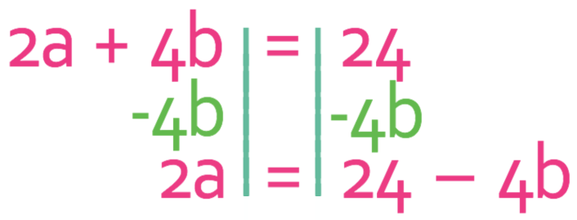
We want the equation to be a = “something” and not 2a. Therefore, we need to divide by 2.
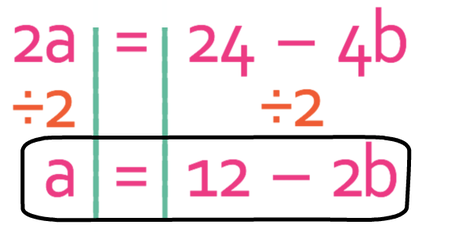
We now sub what we have found for a into the second equation.
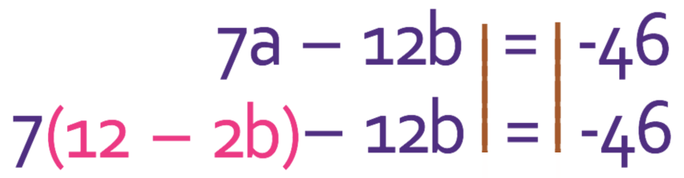
We now expand out the brackets and solve in the usual way.
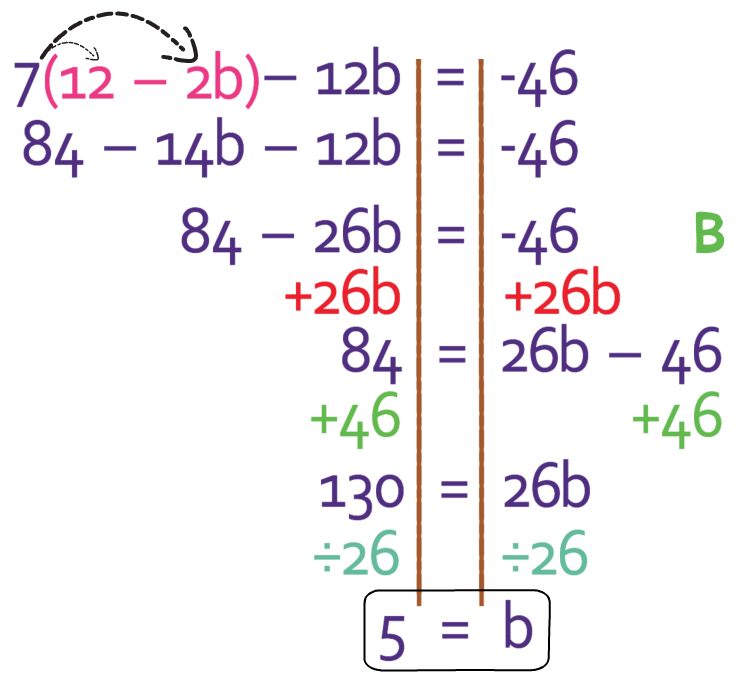
Therefore, b is equal to 5.
We can find the value of a by subbing the value for b that we have just found into one of the original equations; let’s sub it into the first one.
We can find the value of a by subbing the value for b that we have just found into one of the original equations; let’s sub it into the first one.
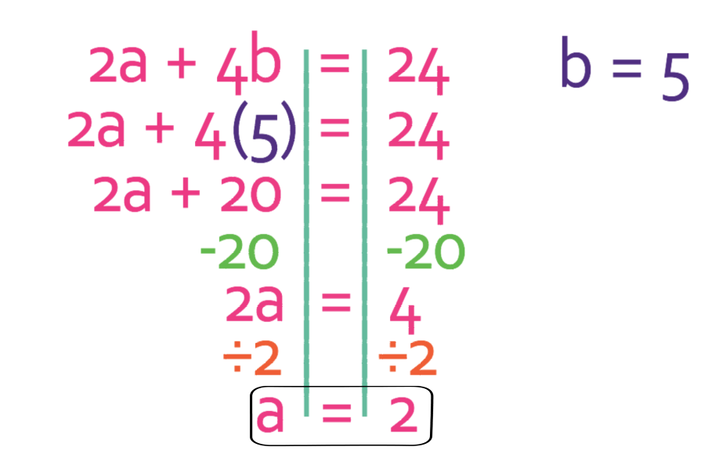
This tells us that a is 2.
We can check that we have the correct values by subbing them into the other original equation; we sub in a as 2 and b as 5.
We can check that we have the correct values by subbing them into the other original equation; we sub in a as 2 and b as 5.
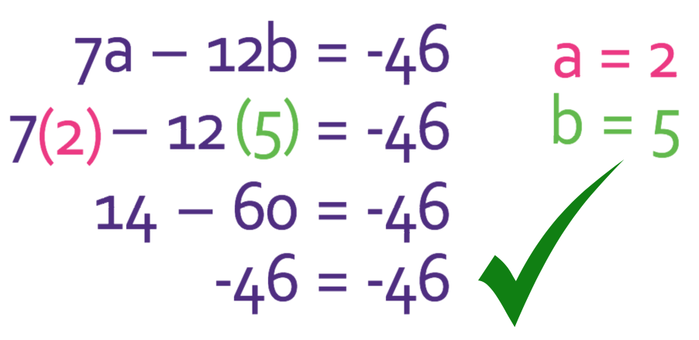
This equation works, which means that a is 2 and b is 5.
Final Note
From the examples in this section, you can see that the substitution method is a bit of a faff when we are solving linear simultaneous equations. However, it becomes a much more useful method when we are solving quadratic simultaneous equations. We will be looking at quadratic simultaneous in a later section; click here if you would like to be taken through to that section straight away.
From the examples in this section, you can see that the substitution method is a bit of a faff when we are solving linear simultaneous equations. However, it becomes a much more useful method when we are solving quadratic simultaneous equations. We will be looking at quadratic simultaneous in a later section; click here if you would like to be taken through to that section straight away.