
2.8 E) Circles – Part 1
An equation for a circle with a centre at the origin [coordinates: (0, 0)] takes the form:

r in the equation above stands for the radius.
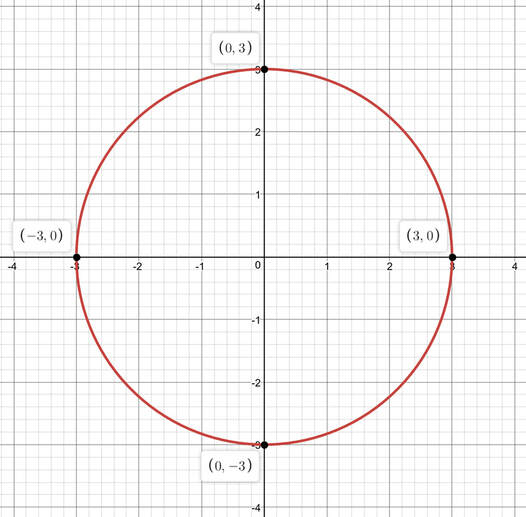
The circle below has the equation x2 + y2 = 9. This circle is going to have a centre at the origin [coordinates (0, 0)] and the radius will be 3 (√9 = 3). The diagram also has the coordinates of where the circle crosses the x and y axis.
If we are given a point that lies on the circle and told that the centre of the circle is at the origin, we are able to work out the radius of the circle by using Pythagoras’ theorem. After we have found the radius, we can find the equation of the circle by subbing the value for the radius into the above equation.
The centre of a circle is at the origin. A point on the circle is (3, 4).
a) What is the radius of the circle?
b) Write down an equation for this circle.
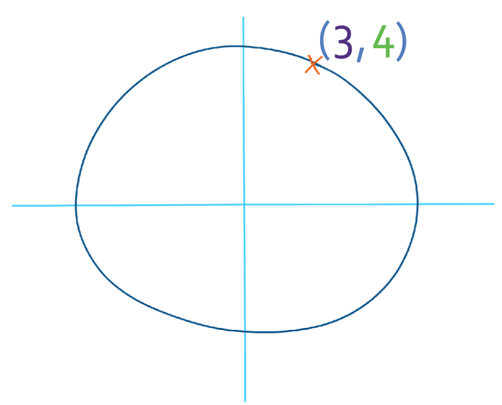
The best step when we are given a word question about anything graphical is to draw a quick sketch showing what is going on. I will be drawing a circle with a centre at (0, 0). I will then mark on the point (3, 4). This sketch does not have to be accurate; it just has to help you have an idea of what is happening.
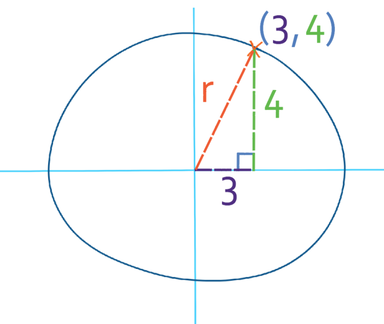
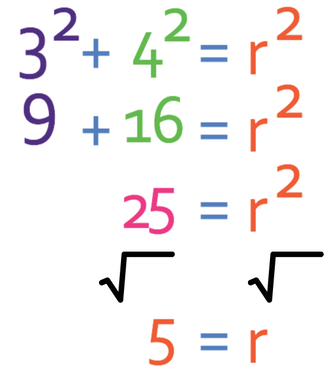
The question asks us to work out what the radius of the circle is, which we can do because we know where the centre of the circle is and a point that lies on the circle. We find the length of the radius by using Pythagoras’ theorem; the square of the hypotenuse is equal to the sum of the squares of the other two sides (for a right-angle triangle). The hypotenuse is the radius and other two sides are the change in x (which is 3) and the change in y (which is 4). Therefore, we have the following calculation:
|
|
Therefore, the radius of the circle is 5 units.
Part b
Part b of the question asks us to find an equation for the circle. We know that the general equation of a circle is: x2 + y2 = r2. We know that r is equal to 5, so we can sub r in to get the actual equation.
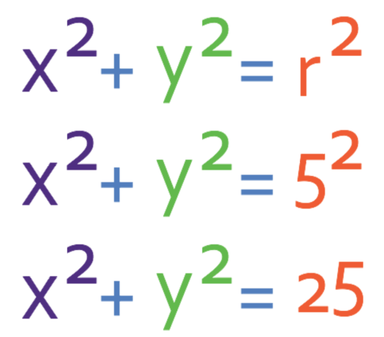
The equation for the circle is x2 + y2 = 25.
An equation of a circle is:

What is the radius of the circle?
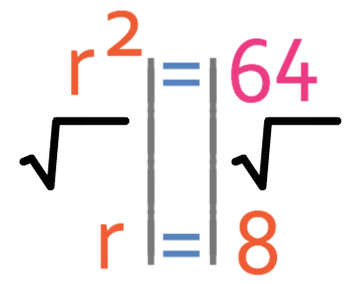
We know that a circle takes the general form x2 + y2 = r2. This means that r2 is 64. Therefore, we obtain r by square rooting 64, which is 8. So, the radius for this circle is 8 units.
A circle has the equation:

Does the point (5, 12) lie on the circle?
We are able to check whether a point lies on a circle (or a line) by subbing the values for x and y into the equation that we are given and seeing if the equation holds (works). If the equation does hold, the point does lie on the circle. If the equation does not hold, it means that the point does not lie on the line.
We are testing whether the point (5, -12) lies on the circle. We check this by subbing in x as 5 and y as -12 into the equation below.
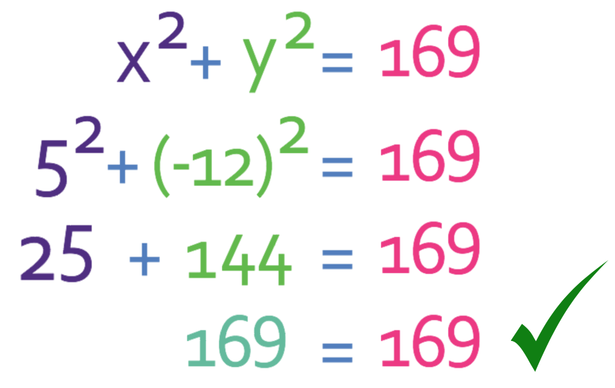
This equation does hold, which means that the point (5, -12) does lie on the circle.