
3.1 I) Proportion with Unknowns
y is inversely proportional to x3. When y is 162, x is a. Find the value of x when y is 6.
The first step in answering this question is to write the general equation down for y being inversely proportional to x3. This equation is written below:
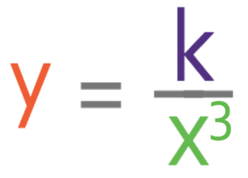
We now need to find the value of k and we do this by subbing in the pair of values that we were given in the question. The question tells us that when y is 162, x is a. Therefore, we sub y in as 162 and x in as a into the general equation.
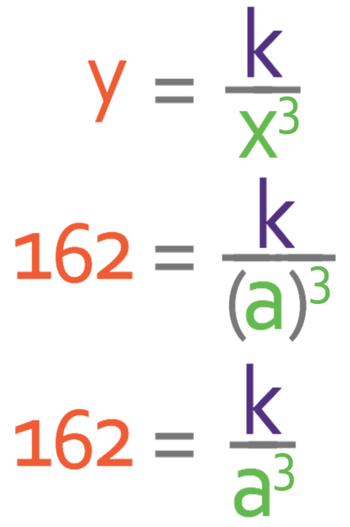
We want to find the value of k and not k divided by a3. We can get rid of the divide by a3 by doing the opposite, and the opposite of dividing by a3 is multiplying by a3. Therefore, we multiply both sides of the equation by a3.
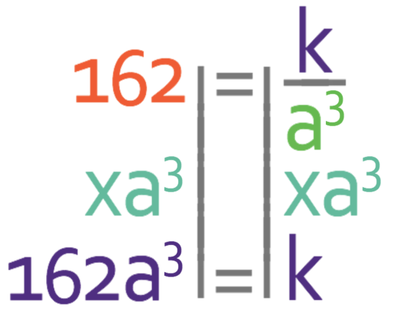
Therefore, k is 162a3. We can replace the k in the general equation with 162a3. The general equation becomes:
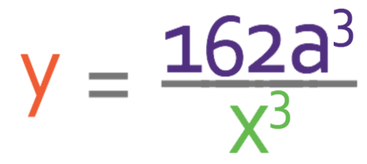
We can use the above equation to work out what the value of x or y is when we are given the value of one of the variables. The question asks us to work out what the value of x is when y is 6. We are able to do this by subbing in y as 6 into the general equation with a known value for k.
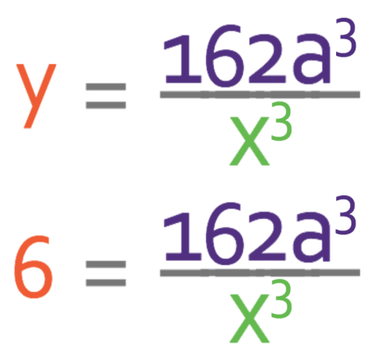
There are two unknowns in this equation; the unknowns are a and x. The question is asking us to work out the value of x, so we complete our working in the usual way to find the value of x. We essentially forget about the a in the equation.
The first step in finding the value of x is to bring the x3 up from the denominator. We can do this by multiplying both sides of the equation by the denominator; we multiply both sides of the equation by x3.
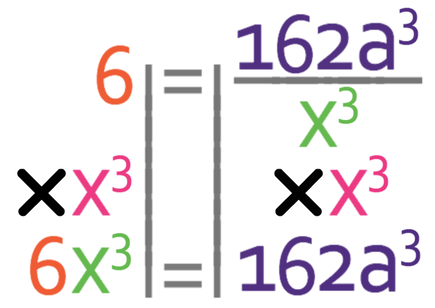
The next step is to get x3 by itself. Currently we have 6x3 and this means that we need to divide both sides of the equation by 6 (we divide both sides of the equation by the coefficient of x3).
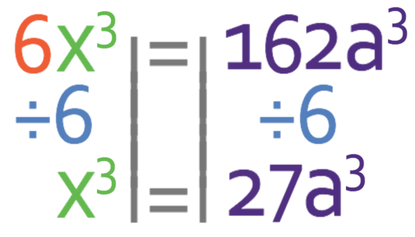
We want to find x and not x3. Therefore, we need to cube root both sides of the equation.
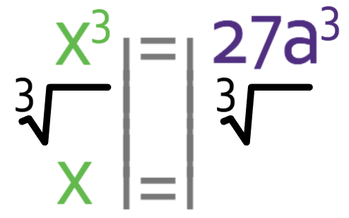
On the right side of the equation, we are cube rooting 27a3. You may find it easier to cube root this by cube rooting the number and the unknown separately. The number is 27 and the cube root of 27 is 3. The unknown is a3 and the cube root of a3 is a. We then combine the cube roots for the number and unknown to get 3a.
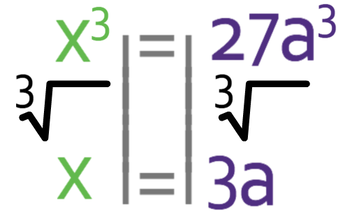
Therefore, when y is 6, x is 3a.