
4.10 H) Trigonometry Graphs
Each of the trigonometry operations have their own graph. The x axis plots the degrees, which we usual refer to as θ or x; positive degrees being on the right of the origin and negative degrees being on the left of the origin. The y axis gives the trigonometry value.
Sin
Let’s start by looking at the graph of sin(θ).
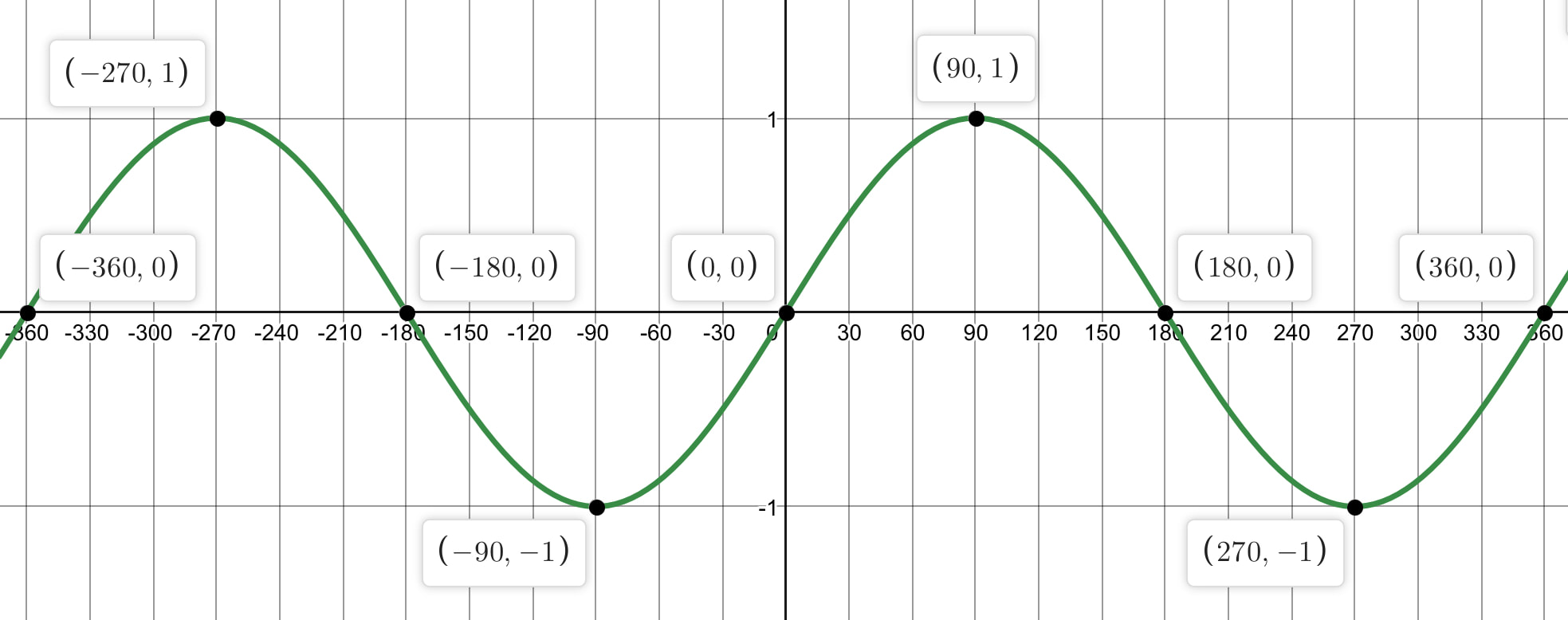
The first fact to mention about sin is that it starts at the origin; If you type sin(0) into a calculator, you will get 0, thus showing that sin starts at the origin.
The maximum value of sin(θ) is 1 and the minimum value is -1. To prove that this is true, we can inverse sin for any value that is greater than 1 or less than -1 and we will see that the calculator will give us a “Math error”. For example, if you type into a calculator sin-1(4) and press equals, you will see that the calculator will show you a “Math error”, thus showing that sin(θ) will never give a value greater than 1. Likewise, you would get this same error if you inversed sin of a number that is smaller than -1; for example, if you typed in sin-1(-7) into a calculator and pressed equals, you would get the same “Math error”.
The maximum value for sin(θ) occurs at 90° (± any multiple of 360°) with a value of 1, and the minimum value for sin occurs at 270° (± any multiple of 360°) with a value for -1.
The period of sin(θ) is 360°. The period means the number of degrees that it takes for one complete cycle to occur. To prove that this is true, we can find sin of any value and write the answer down, such as:

We can then type into the calculator sin of the degree that you type in plus 360°; for my example I would type in:

The answer will be exactly the same as before, thus showing that the cycle of sin is 360°. The same would be true if we took 360° off the original value that we typed into the calculator.
Cos
The graph of cos(θ) is shown below.
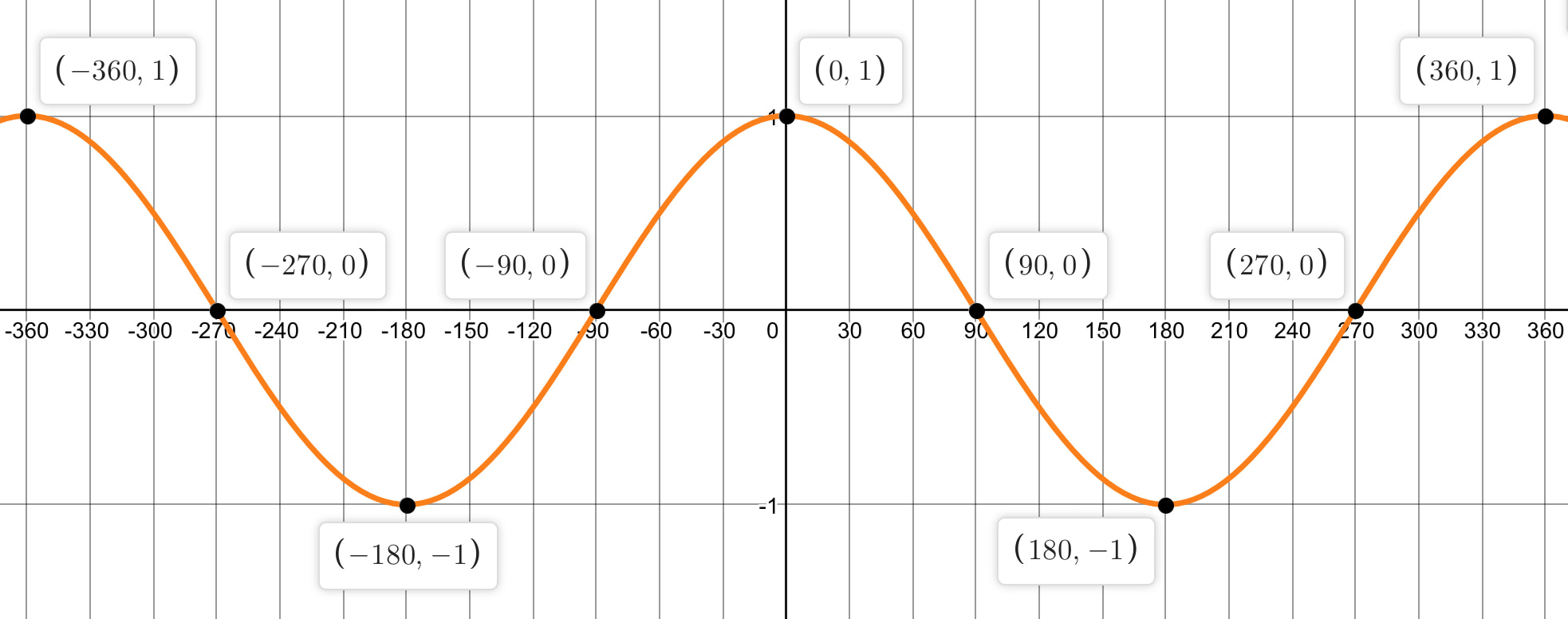
The cos graph starts at 1; cos(0) = 1. Cos(θ) has a maximum value of 1 and a minimum value of -1. We can prove that this is true by typing the inverse of cos for any value that is either greater than 1 or less than -1. When we do this, we will see that the calculator will give us a “Math error”. For example, we would obtain a “Maths error” if we typed into the calculator cos-1(3) or cos-1(-1.2).
The maximum value of cos occurs at 0° (± any multiple of 360°) with a value of 1 and the minimum value of cos occurs at 180° (± any multiple of 360°) with a value of -1.
The period of cos(θ) is 360°; cos and sin have exactly the same period. We can prove that this is true by trying the same test as before, but instead of typing in sin, we type in cos. For example:
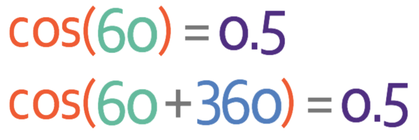
This would also have been true if we had taken 360° off instead of adding 360° on.
Tan
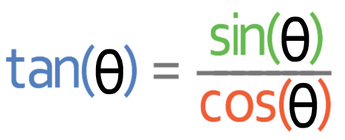
Tan(θ) is equal to sin(θ) divided by cos(θ).
The graph of tan(θ) is shown below.
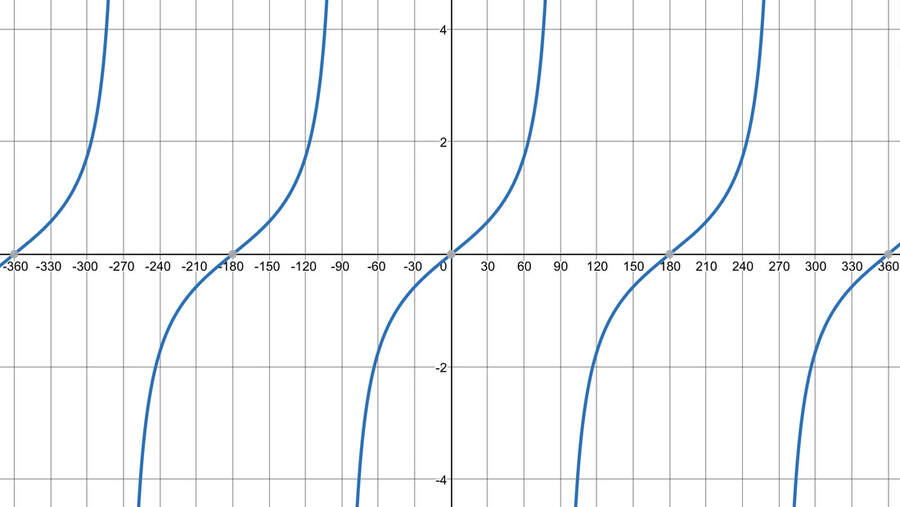
We can work out what the value of tan(θ) will be based on the values of sin(θ) and cos(θ). Whenever, sin(θ) is 0, tan(θ) will also be zero. This is because 0 divided by anything is 0. Therefore, tan(θ) is zero at 0°, 180°, 360° and anymore multiples of 180°.
The next thing to remember with the graph of tan(θ) is that we cannot divide by 0. Therefore, we do not have a value for tan(θ) whenever the value for cos(θ) is 0. This means that tan(θ) does not have a value at 90°, 270°, 450° etc. The value for tan(θ) at these points is known as being undefined. You can see that this is the case by typing in tan of any of the values just mentioned into the calculator. When you type them into a calculator, you will obtain a “Math error”. For example, you will obtain a “Math error” when you type tan(90) into a calculator.
As the value for cos(θ) approaches 0, the value for tan(θ) increases exponentially. This is because we are dividing by an ever-smaller number, thus meaning that the outcome becomes larger and larger. The undefined values for tan(θ) are asymptotes to the tan(θ) curve. The sketch of tan(θ) has asymptotes where θ = -90, θ = 90 and θ = 270 etc...