Elevise
  • Home
  • GCSE Maths
  • GCSE Science
Back to AQA Trigonometry (H) Home
4.10 M) The Sine Rule – Finding an Angle
In the previous section, we had a question that asked us to find the length of an unknown side. In this section we are going to be looking at finding the size of an unknown angle.
 
There are two different cases that we need to consider when we are working out the size of an unknown angle. The different cases depend on the size of the unknown angle. If the angle is acute (like example 1), we pretty much complete the working as you would expect. If the angle is obtuse, the working is slightly different, and we go through how answer questions like this in the second example.
 
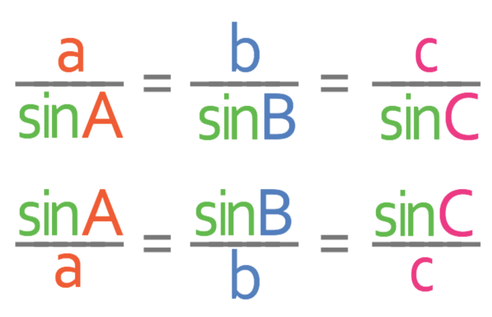
The two versions of the sine rule are given below. 
Picture

Example 1 – An Acute Angle
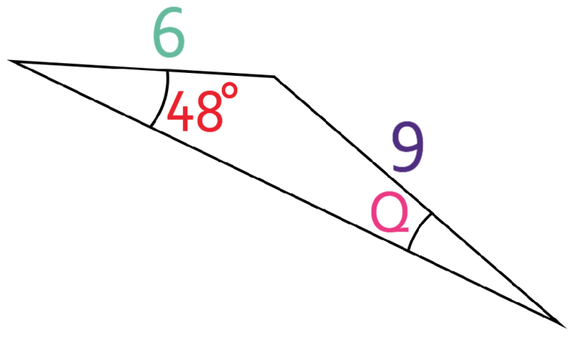
Angle Q is an acute angle. Find the size of angle Q to 3 significant figures. 
Picture
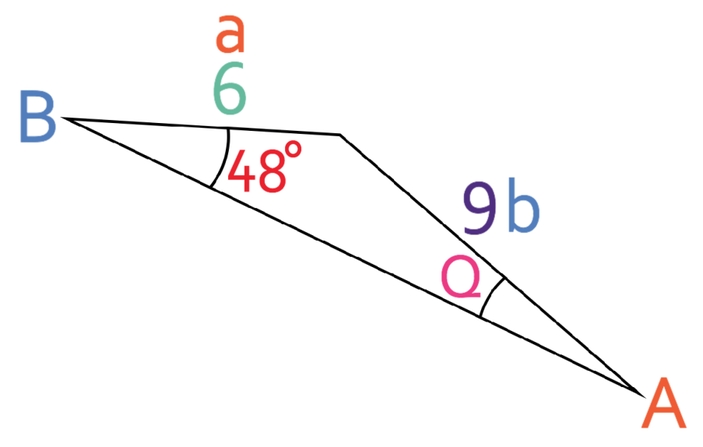
We are looking for angle Q, which I am going to label as A. The next step is to label the side that is opposite angle Q. The side that is opposite is the side that has a length of 6; we label this side a.
 
We now move onto labelling the other side and angle. Let’s label the angle that is 48° B and the side that is opposite b (the opposite side has a length of 9).
 
The labelled-up triangle is given below. 
Picture
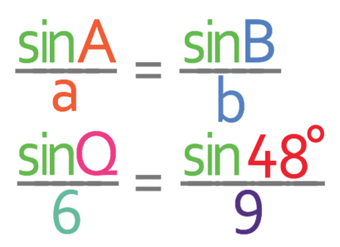
We are now ready to use the sine rule and sub the values into their appropriate place. As we are finding the size of an angle, it is best to use the formula that has the angles as numerators. 
Picture
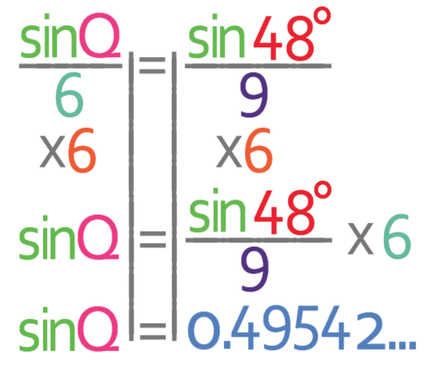
The next step is to get rid of the denominator on the left side of the equation, which we do by multiplying both sides by 6.
Picture

We need to make sure that we do not round this answer. Your calculator should keep this as “ans” providing that you do not calculate anymore sums on the calculator.


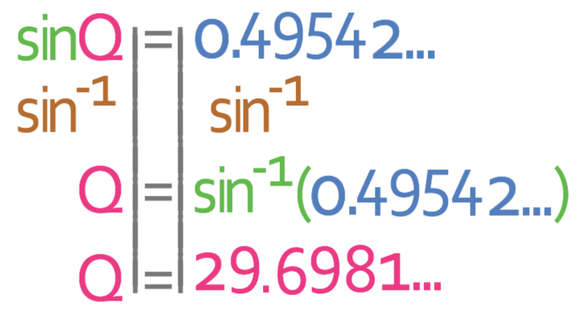
This gives us what sinQ is. However, we want to know what Q is and not what sinQ is. Therefore, we need to get rid of sin, which we do by inversing sin. Therefore, we sin-1 both sides of the equation.
Picture
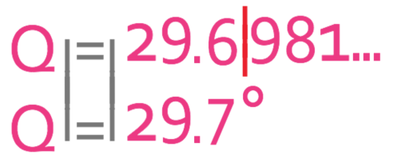
We are asked to give the answer to 3 significant figures. We count the significant figures from the left starting from the first non-zero number. We place a line after the third significant figure and check the number that is to the right of the red line.
Picture
The number to the right of the red line is greater than 5, which means that we round the answer up. Therefore, angle Q to 3 significant figures is 29.7°. 

Example 3 – An Obtuse Angle
Sometimes we will be asked to find an angle in the triangle and the angle will be obtuse rather than acute. Obtuse angles are angles that are greater than 90° and less than 180°. The process for answering questions like this is exactly the same as the previous question up until the last part. I am going to explain how to answer questions like this through an example.
 
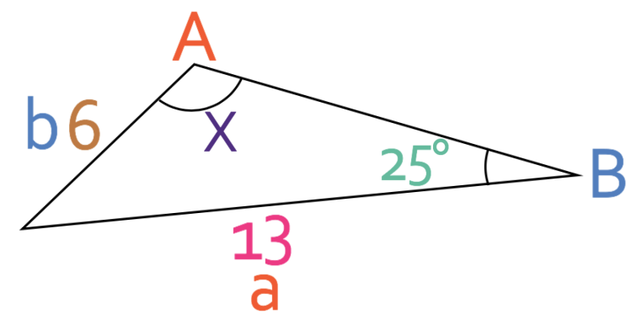
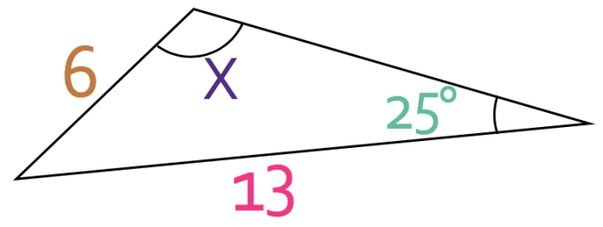
Angle X on the triangle below is obtuse. Find the size of angle X giving your answer to 1 decimal place.
Picture
​The first step in answering this question is to label the triangle up. I am going to label the angle that we are looking for A and the side opposite this angle a (the side that is 13 units). I then label the other angle (the angle that is 25°) B and the side that is opposite this angle b (the side that is 6 units). The labelled up triangle is shown below. 
Picture
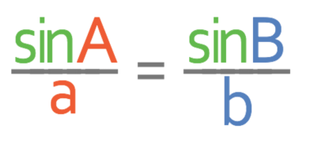
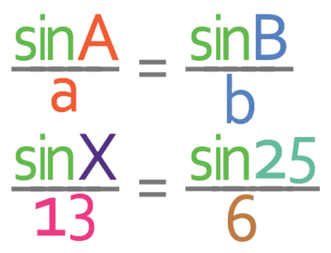
We are finding the angle, which means that it is best to use the sine rule where the angles are the numerators and the sides are the denominator. The sine rule formula that we are going to use is shown below. 
Picture
We now sub the values from the labelled up triangle into this formula. 
Picture
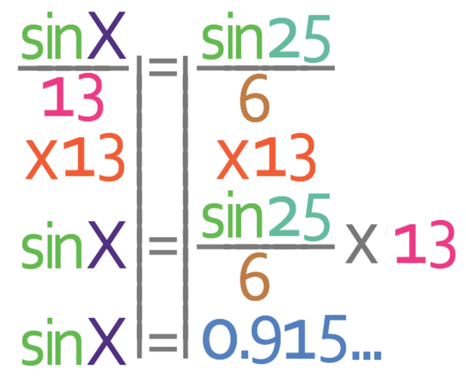
The first step in finding the value of X is to multiply both sides of the equation by 13.
Picture

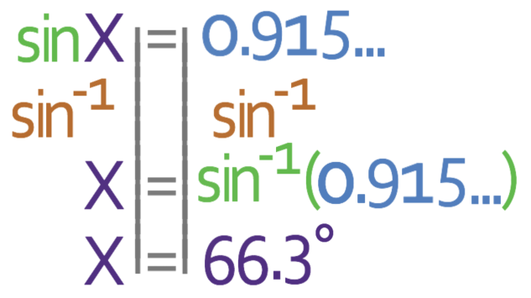
We want to find the value of X and not sinX. Therefore, we need to get rid of the sin and we are able to do this by taking the inverse of sin from both sides; we sin-1 both sides of the equation.
Picture
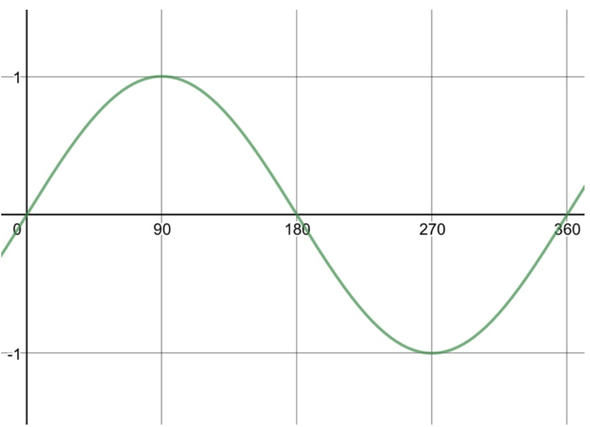
This gives us X as 66.3…° and this would be the answer if we were told that angle X was acute. However, we are told at the start of the question that angle X is obtuse, thus meaning that 63.3° cannot be the size of the angle. We are able to work out the size of the angle by drawing out the graph of sin(X) and the graph of sin(X) for X values between 0° and 360° is shown on the graph below.
Picture
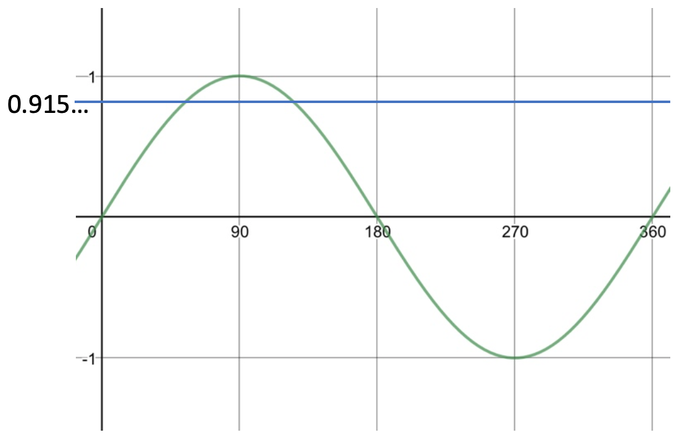
From the above graph we can see that difference value for X for sin(X) give the same y values. When we were answering the question, we found that sin(X) was equal to 0.915…. I am going to find 0.915… on the y axis and draw a horizontal line across. Any point of intersection between the sin curve and the horizontal line at 0.915… will be a potential solution for X. 
Picture

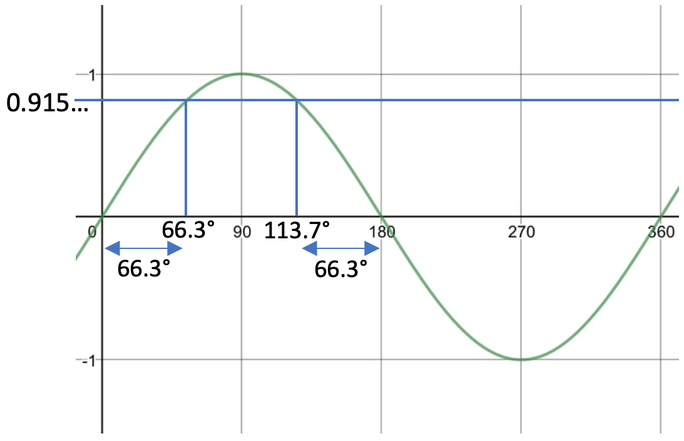
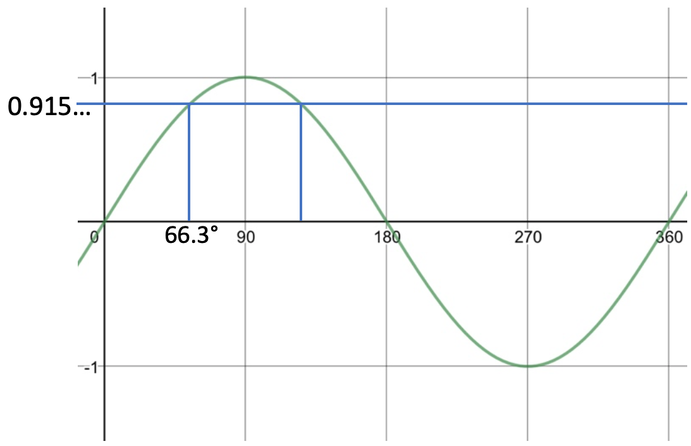
From the graph above, we can see that there are 2 points of intersection and this means that there are 2 possible values for X. The first value for X will be the value that we found when we found the inverse of sin for 0.915… [sin-1(0.915…)]. This value will be 66.3° and this is shown on the graph below.

Picture
The sin graph is symmetrical around 90°. This means that the distance between the original and the first solution that we have found (66.3°) will be the same as the distance between 180° and the second solution. This means that we are able to find the second solution by taking 66.3° from 180°. 
Picture
This tells us that the second solution is 113.7° and I have labelled this on the graph below. 
Picture
​The second solution that we have found is 113.7° and this angle is obtuse. This means that the size of angle X is 113.7°. 

Alternative Method
There is a slight cheat method that you can use to find the size of an obtuse angle when using the sine rule. This method involves you taking the acute angle for the angle that you are looking for off of 180°. So, for the above example, the acute angle for what we were looking for was 66.3°. Therefore, we would find the obtuse angle by taking 66.3° off of 180°. 

Picture
This tells us that the obtuse angle that we are looking for is 113.7°.
 
This method is a quick method to find the answer and it is perfectly fine to use. However, it is worth trying to get your head around the longer method because you will understand where this rule comes from and by doing this, it will make it easier to remember the rule. 
Home
GCSE Maths
GCSE Science
Tuition
United Kingdom
[email protected]
  • Home
  • GCSE Maths
  • GCSE Science