
4.7 D) Area of Circles

Let’s have a few examples.
What is the exact area of the circle below? Do not use a calculator.
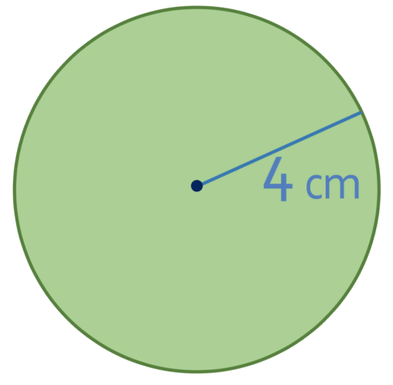
To find the area of the circle we are going to be using the formula that has been given to us at the top of this section. The formula requires us to know the radius of the circle and we can see from the diagram that the radius is 4 cm. We now sub r into the equation as 4.
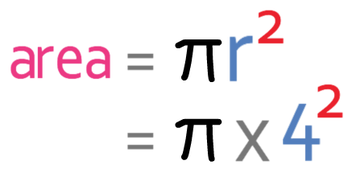
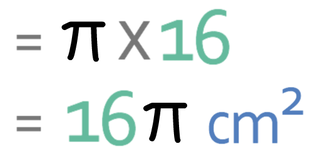
Therefore, the exact area of the circle is 16π cm2.
What is the area of the following circle below? Give your answer to two decimal places. You may use a calculator.
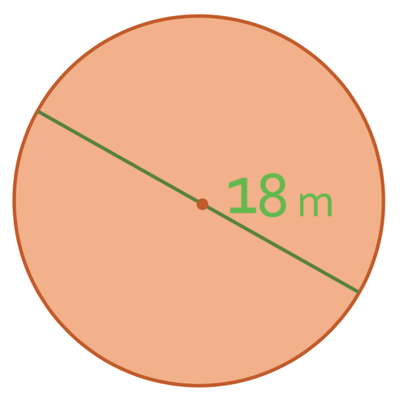
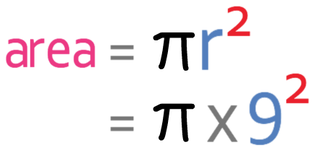
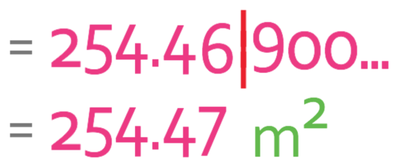
The area of this circle is 254.47 m2.
Working Backwards
We are now going to have an example where we are given the area of a circle and asked to work out what the radius of the circle is. We answer questions like this by setting the formula that we use to find the area equal to the area that we are given. We then solve to find what we are looking for (in this case, we solve to find the radius).
Example 3
The circle below has an area of 25π cm2. What is the radius of the circle?
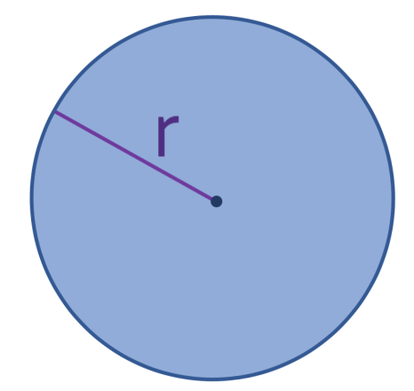
The first step in answering this question is to set the formula that is used for finding the area of the circle (πr2) equal to the area of the circle that we are given (25π cm2). This gives us the equation below:
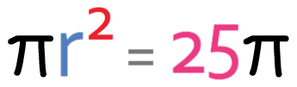
Both sides of the equation have a π in them. Therefore, the first step in finding the radius is to divide both sides of the equation by π.
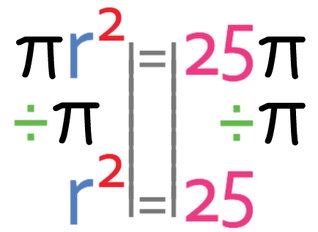
We want to find the value of r and not r2. Therefore, we need to square root both sides of the equation.
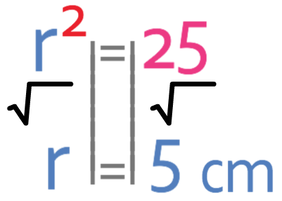
This tells us that the radius of the circle is 5 cm.