3.3 C) Simplifying Ratio – Part 3
Simplify the following ratio.
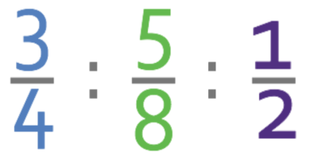
Method 1 – Multiply by the LCM
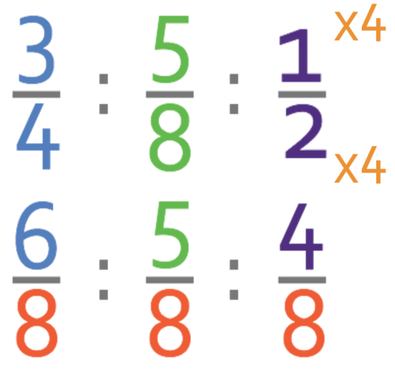
One method to simplify ratios that contain fractions is to multiply all of the components in ratio by the lowest common multiple between all of the denominators of the fractions involved. The lowest common multiple of the denominators is the lowest number that all of the denominators go in to. By multiplying each of the components in the ratio by the lowest common multiple, we ensure that all of the denominators in the fraction are got rid of. The lowest common multiple between 4, 8 and 2 is 8. Therefore, we are going to multiply each of the components by 8 (it may be easier to multiply each of the components by 8/1 because we are dealing with fractions).
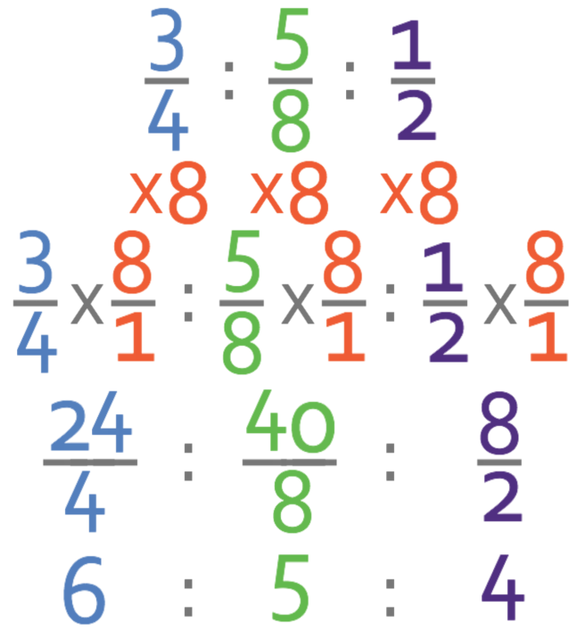
You may be able to take a shortcut when multiplying by 8. This is because you might be able to see that for the first term we are multiplying by 8 and dividing by 4. This is the same as multiplying by 2, so we multiply the numerator by 2, which gives us 6 (3 x 2). For the second term, we are multiplying by 8 and divide by 8, which means that the value of the numerator does not change; it remains as 5. For the final term, we are multiplying by 8 and then dividing by 2. This is the same as multiplying the numerator by 4. This means that the final term is 4 (1 x 4).
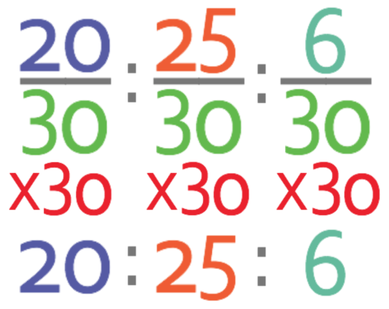
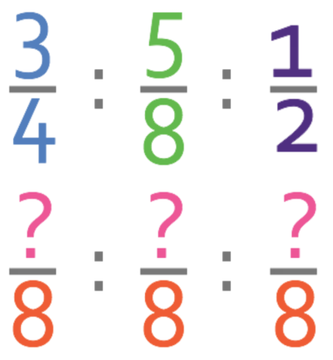
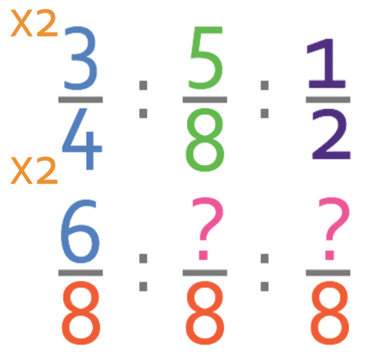
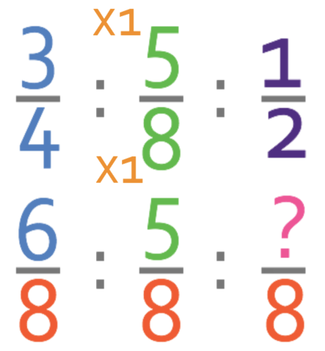
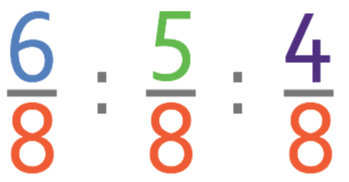
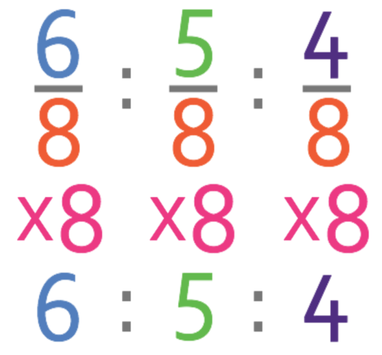
This method is to create equivalent fractions that all have the same denominator. When our fractions in our ratio have the same denominator, we will then multiply all of the terms by the denominator, which will just leave the numerators in our ratio.
The denominators of all of the fractions will be the lowest common multiple between all of the three denominators. We found out when looking at the first method that the lowest common multiple between the denominators was 8, so all of the three fractions in the ratio will be 8.
Simplify the following ratio:
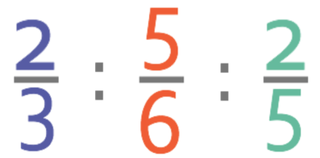
The easiest way to find the LCM for the denominators (3, 6 and 5) is to list the multiples of each of these numbers and then find the first number that appears in all of the multiple lists. The multiples for the 3 different denominators (3, 6 and 5) are shown below:
- 3 – 3, 6, 9, 12, 15, 18, 21, 24, 27, 30, 33…
- 6 – 6, 12, 18, 24, 30, 36…
- 5 – 5, 10, 15, 20, 25, 30, 35…
We can see that the lowest common multiple between 3,6 and 5 is 30. Therefore, we are going to multiply each of the components of the ratio by 30 (it may be easier to multiply them by 30/1).
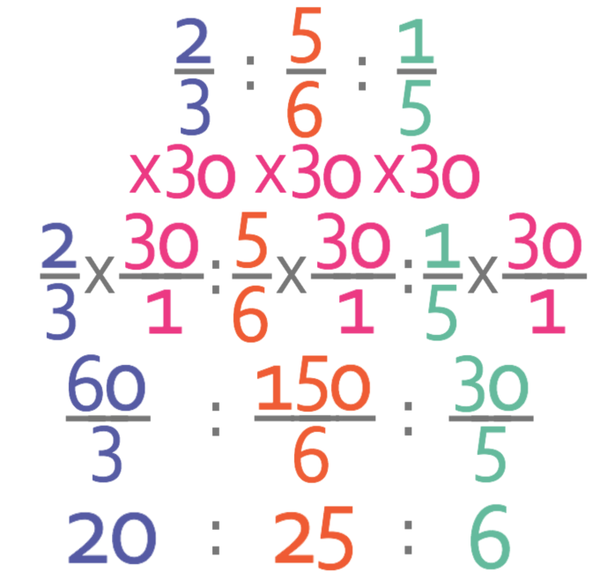
Method 2 – Getting the Denominators the Same
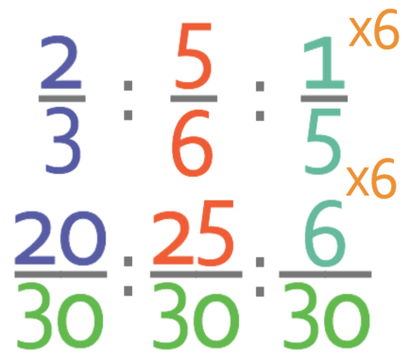
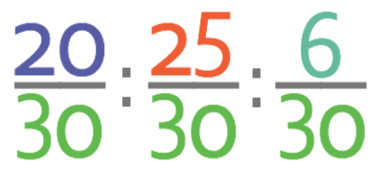
The second method is all about getting the denominators of the fractions the same and then multiplying all of the fractions by this common denominator to get rid of the denominator. The common denominator will be the lowest common multiple for 3, 6 and 5. We have already established that the lowest common multiple for these numbers is 30. Therefore, we want all of the denominators of the fractions to be 30.
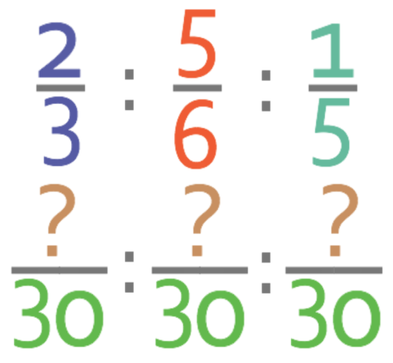
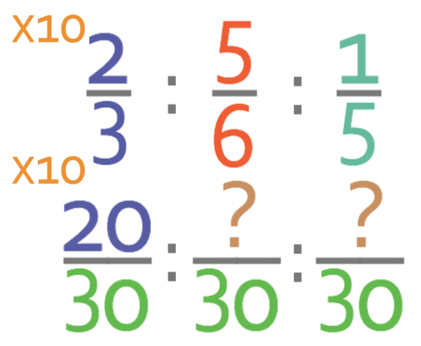
Let’s start by looking at the first fraction in the ratio. The first fraction is 2/3. The denominator is currently 3 and we want the denominator to be 30. Therefore, we need to multiply the denominator and the numerator by 10 (we find the value of 10 by dividing the number we want (30) by the number that we currently have (3); 30 ÷ 3 = 10).
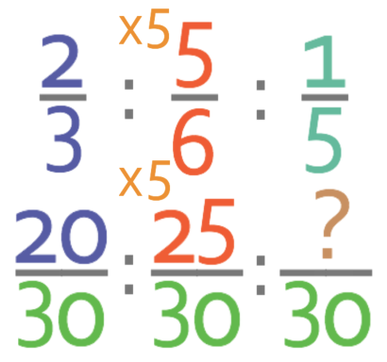
We now do the same for the second component of the ratio, which is 5/6. Currently, the denominator of this fraction is 6 and we want to get it to equal 30 and this means that we need to multiply the numerator and the denominator by 5 (30 ÷ 6 = 5).
Now, we need to do the same with the final fraction. The final fraction is 1/5. The current denominator is 5 and we want it to be 30, so we need to multiply the numerator and the denominator by 6 (30 ÷ 5 = 6).