
1.6 B) Multiplication
When we multiply indices that have the same base, we add the power.
Example 1
Simplify:

To start with I am going to rewrite each of the terms without indices.

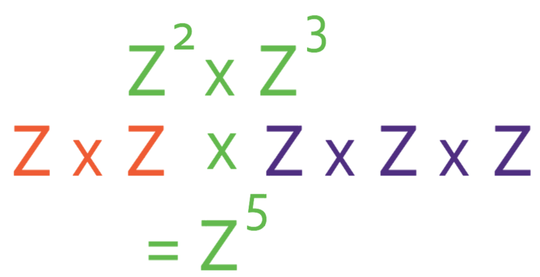
Therefore, we can write the calculation as:
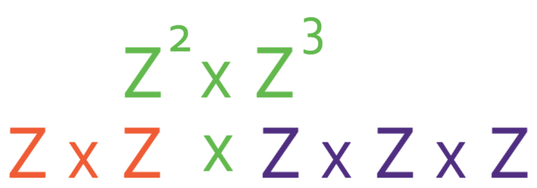
Z (which is our base) has been multiplied by itself 5 times (which is the power), which means that we can rewrite Z2 x Z3 as Z5.
Another way to obtain the answer is to remember the rule, which states that when we are multiplying powers that have the same base, we add the powers. This means that we get the following calculations.
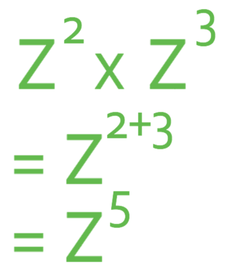
This gives us the same answer as when we wrote out each of the terms without indices.
The writing of each of the terms out in full was there to show you where the rule comes from/ to prove that the rule works. From now on you can just use the rule, which is that we when we multiply powers with the same base, we add the powers together.
Example 2
What is:
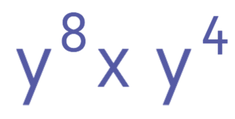
The bases of the power are the same, which means that we are able to add to powers to obtain our answer.
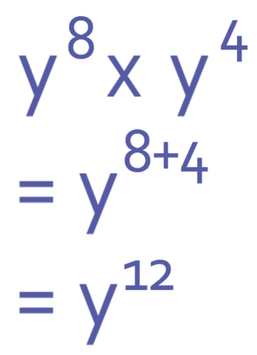
The answer is y12.
Whenever we are multiplying powers, we need to ensure that the bases are the same. For example, we would not be able to add the powers for 45 x 62 and this is because the bases are not the same.
We follow the rule for multiplication, even if we have a negative power. We will be looking at what a negative power means later on in this whole indices section.