ELEVISE
  • Home
  • GCSE Maths
  • GCSE Science
Back to Edexcel Probability (H) Home
​​5 D) Probability of an Event Not Happening
With mutually exclusive events, we can work out the probability of an event occurring in two different ways. We are going to use these two methods for the following example.

Example 1
A fridge contains 4 different flavoured yoghurts in the following quantities:
  • 7 strawberry
  • 1 apricot
  • 3 blackcurrant
  • 4 peach
 
What is the probability of not picking a blackcurrant yoghurt? 

Method 1
The first method is to use the following formula:

Picture
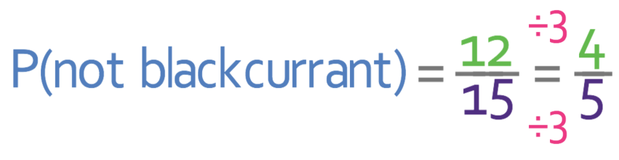
The number of times that the event occurs is the number of yoghurts that are not blackcurrant flavoured. There are four flavours and three of the flavours are not blackcurrant (strawberry, apricot and peach). There are 7 strawberry yoghurts, 1 apricot yoghurt and 4 peach yoghurts. Therefore, there are 12 yoghurts that are not blackcurrant flavoured. Therefore, the numerator in the above formula is 12.
 
The denominator is the number of possible outcomes and we obtain this figure by finding the number of yoghurts that are in the fridge. There are 7 strawberry yoghurts, 1 apricot yoghurt, 3 blackcurrant yoghurts and 4 peach yoghurts. This means that there are 15 yoghurts in total, so the denominator is 15. Therefore, the probability of not picking a blackcurrant yoghurt is:

Picture
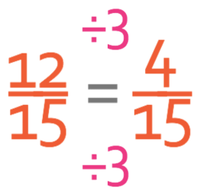
We have given our answer as a fraction, so we need to make sure that the fraction is in its simplest form. The numerator and the denominator have a common factor of 3, so we divide both the numerator and denominator by 3.
Picture

The probability of not picking a blackcurrant yoghurt is 4/5.


Method 2
These events are mutually exclusive, which means that the event either does happen or does not happen; it cannot happen and not happen at the same time. This means that the probability that the event will happen and the probability that the event will not happen will add up to 1.

Picture
We are able to rearrange this formula to make it more useful for working out the probability that an event does not happen and we do this by making “P(event does not happen)” the subject of the equation. We can make “P(event does not happen)” the subject by moving the “P(event happens)” from the left side of the equation to the right. We are able to do this by taking “P(event happens)” from both sides of the equation. 
Picture
I am going to modify the above equation so that it has the wording for the example. 
Picture

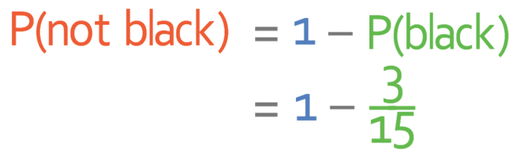
In order to use the equation above, we need to find out what the probability of the event happening is; in this case, we are looking for the probability of picking a blackcurrant yoghurt. There are 3 blackcurrant yoghurts and there are 15 yoghurts in total. This means that the probability of picking a blackcurrant yoghurt is 3/15. Let’s sub this into the equation.
Picture

As we are working with a fraction, it is easier if we convert the 1 in the equation to a fraction; I am going to write the 1 as 1/1.
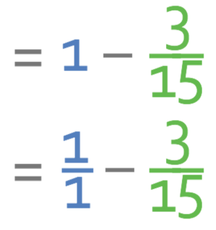
Picture

When we are subtracting fractions, we need to make sure that the denominators of the fractions are the same. I am going to make the denominators of both fractions 15. This means that we multiply the numerator and denominator of the first fraction by 15 resulting in the fraction becoming 15/15.
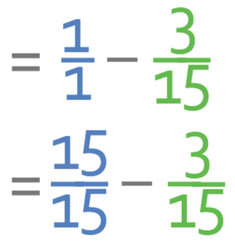
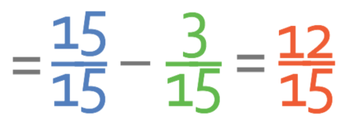
Picture
​The denominators of both fractions are 15. We subtract fractions by taking the numerators away and keeping the denominator the same. 
Picture
The final step is to check whether the fraction can be simplified. The numerator and denominator have a common factor of 3. Therefore, we divide both the numerator and denominator by 3.
Picture
This method gives us the same probability as the other method.

Example 2
A bag contains some balls. The probability of picking a green ball is 0.3. What is the probability of not picking a green ball?
 
We will only be able to answer this question by using the second method. The second method involves the formula below:

Picture
I am going to modify the above equation so that it has the wording for the example. 
Picture
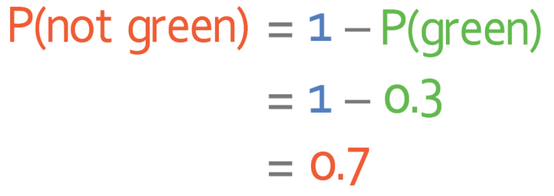
​We are told in the question that the probability of picking a green ball is 0.3. We can sub this value into the above equation and carry out the calculation to find the probability of not picking a green ball. 
Picture
Therefore, the probability of not picking a green ball is 0.7. 

Final Note
The formula to remember for working out the probability of an event not happening is given below. 
Picture
It is worth making a note of this formula on a revision card. 
Home
GCSE Maths
GCSE Science
Tuition
United Kingdom
[email protected]
  • Home
  • GCSE Maths
  • GCSE Science