
Back to OCR Algebra Introduction (H) Home
2.1 I) Expanding Double Brackets – Part 2
2.1 I) Expanding Double Brackets – Part 2
Example 1
Expand and simplify the brackets below.
Expand and simplify the brackets below.

We are still going to be using FOIL to expand these brackets. We just have to be more careful because the terms that are in each of the brackets are more complex than the terms in the examples in the previous section.
We multiple the First terms first: 2a2b x 3ab4 = 6a3b5
Next, we multiply the terms on the Outside of the brackets: 2a2b x 12 = 24a2b
Multiply the Inside of the brackets: (-4b3) x 3ab4 = -12ab7
Finally, multiply the Last two terms: (-4b3) x 12 = -48b3
We combine all of these values to give us:
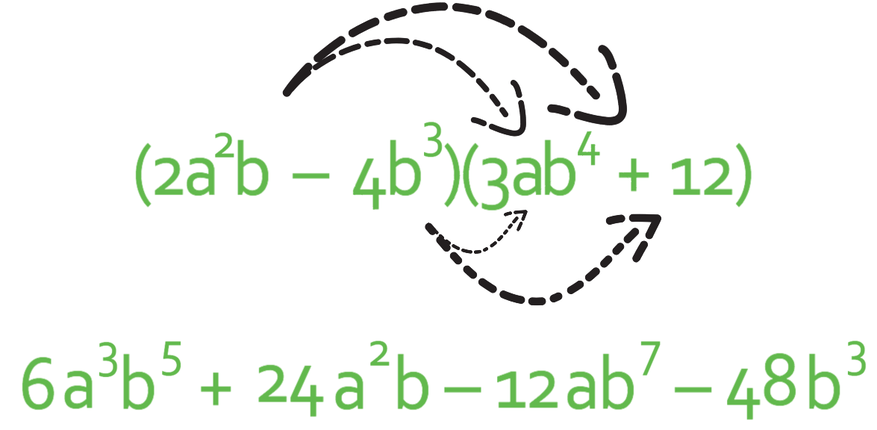
None of the terms are the same, which means that the answer above is in its simplest form.
Triple Brackets
The easiest way to multiply 3 brackets is to multiply two of the brackets out first, simplify and then multiply the simplified result by the bracket that we haven’t yet multiplied out by. It does not matter which brackets you multiply out first.
The easiest way to multiply 3 brackets is to multiply two of the brackets out first, simplify and then multiply the simplified result by the bracket that we haven’t yet multiplied out by. It does not matter which brackets you multiply out first.
Example 2
Expand the bracket below.
Expand the bracket below.

The first step to answering this question is to expand out two of the brackets. It does not really matter which brackets you choose to expand out, but I am going to expand the first two brackets. I am going to be using the foil method to expand these brackets (First, Outside, Inside and Last).
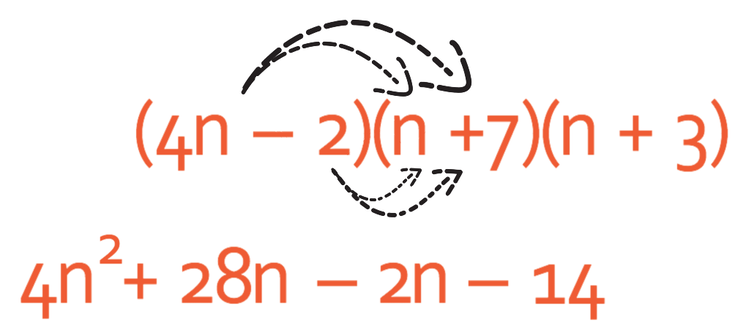
We then simply the result from the multiplication of the first two brackets.
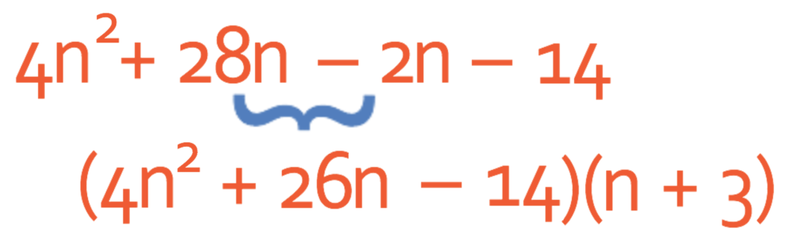
The next step is to multiply out these two brackets. I am going to rearrange the brackets whereby the bracket with two terms is first and the bracket with three terms is second. This does not change the outcome of the multiplication of these brackets (I just think that it is slightly easier to multiply the brackets out this way).

When we are multiplying out the brackets above, we need to ensure that the two terms in the first bracket are multiplied by all 3 terms in the second bracket. I am going to multiply all of the terms in the second bracket by n, and then multiply all of the terms in the second bracket by 3.
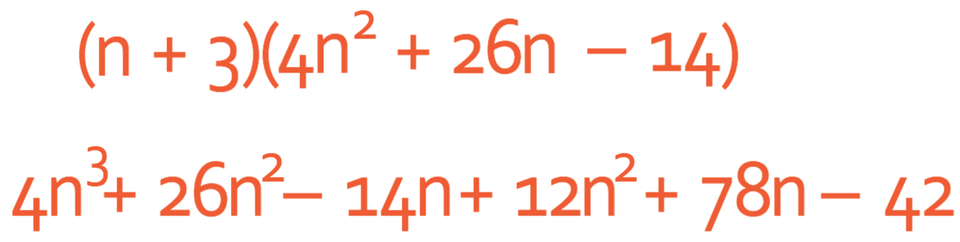
The final step is to simplify the expression above by collecting like terms.
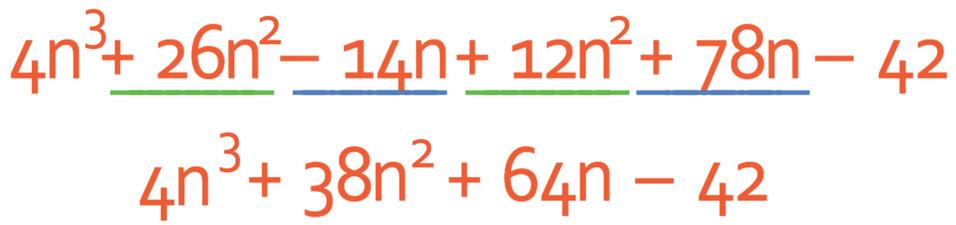
We now have the simplified expression.