
Electricity demand changes throughout the day and producers need to make sure that they produce enough electricity so that everyone has the electricity that they need and there are no blackouts. Electricity producers are able to predict electricity demand at different times during the day and make appropriate generation decisions based on their predictions. For example, there is low electricity demand at night as most people are sleeping, and there is considerably higher electricity demand when people get up in the morning and when they get home from work or school in the evening. Electricity demand can also be influenced by popular sporting events on TV such as the world cup. A lot of power stations run at below maximum capacity, so that if there is a surge in demand for electricity, they can increase the amount of electricity that the power station generates, thus reducing the chances of a blackout.
The National Grid uses cables to transport electrical power from where it has been produced to where it is needed. To transport a large quantity of power, you need a high potential difference (voltage) or a high current. This is because power is potential difference multiplied by current.

The national grid uses transformers to change the potential difference and current of the electricity. There are two different types of transformers; step-up transformers and step-down transformers. The diagram below shows the locations of the step-up and step-down transformers with respect to power stations and consumers (households).
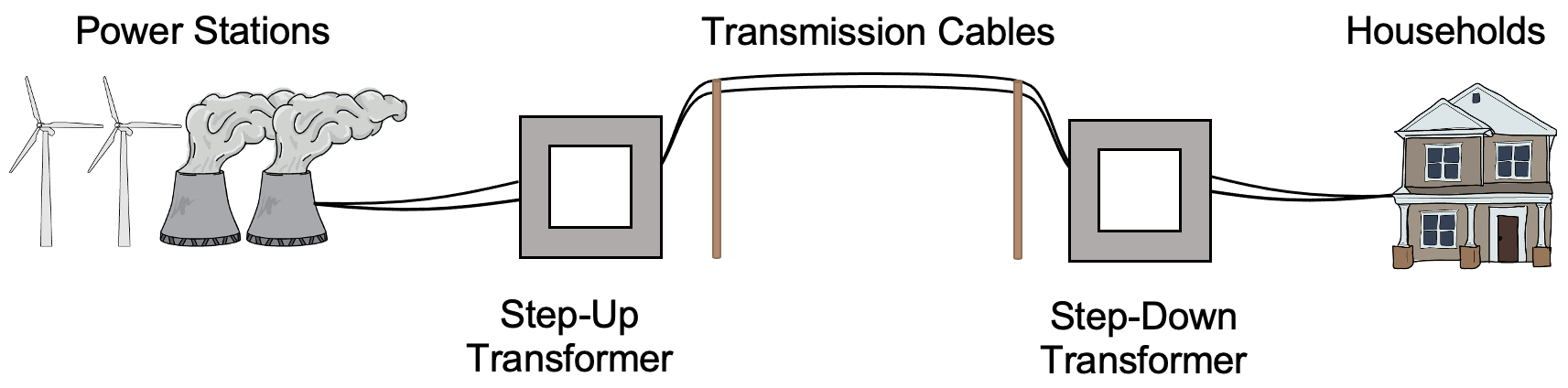
After passing through a step-up transformer, the electricity travels through high voltage transmission lines to where it is needed. The transmission lines are held up by very high pylons.
When the electricity has travelled to where it is going to be used, it passes through a second transformer known as a step-down transformer. A step-down transformer reduces the potential difference to a safe level/ the level that is required; step-down transformers also increase the current. If the electricity is going to households, the step-down transformer will bring the potential difference of the electricity down to 230 V.
The diagram below shows a transformer in more detail.
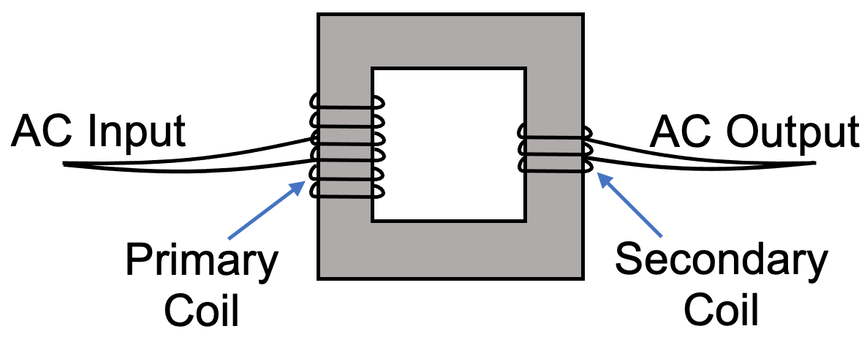
A step-up transformer increases the potential difference and decreases the current. In order for a step-up transformer to increase the potential difference, there must be more turns on the secondary coil than the primary coil.
A step-down transformer decreases the potential difference and increases the current. In order for a step-down transformer to decrease the potential difference, there must be more turns on the primary coil than the secondary coil.
We are able to work out power by multiplying the potential difference by the current.


Example 1
We have a transformer. For the primary coil, the potential difference is 240 V and the current is 0.25 A. The secondary coil has a current of 5 A.
a) Find the potential difference in the secondary coil.
b) Is the transformer a step-up or a step-down transformer?
Part a
The first part of the question asks us to work out the potential difference in the secondary coil. We are able to do this by using the equation below.
We are told in the question that the PD of the primary coil is 240 V (Vp), the current for the primary coil is 0.25 A (Ip) and the current for the secondary coil is 5 A (Is). We sub these values into the formula and solve to find the potential difference in the secondary coil (Vs).
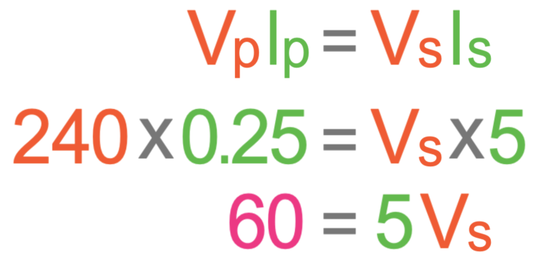
We want Vs and not 5Vs, so we divide both sides of the equation by 5.
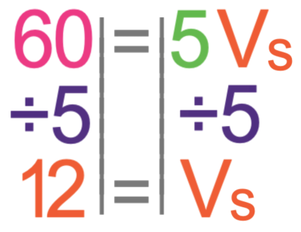
The potential difference across the secondary coil is 12 V.
Part b
The second part of the question asks us to say whether the transformer is a step-up or step-down transformer. A step-up transformer increases the potential difference (and decreases the current). A step-down transformer decreases the potential difference (and increases the current). The potential difference in the primary coil was 240 V and the potential difference in the secondary coil was 12 V; the potential difference across the coils has decreased, which means that this transformer is a step-down transformer.