
Back to P2 Home
P2: Quiz 3
P2: Quiz 3
Click here for a printable PDF of the circuit in this quiz.
1) Give a definition and the units for the following:
a) Current
b) Potential difference
c) Resistance
2) Write down the equation that links current, potential difference and resistance. Also, write down the formula triangle.
3) A circuit contains a 4 Ω fixed resistor that has a potential difference across it of 12 V. Calculate the current.
4) A component has a resistance of 3 Ω and a current of 5 A. Calculate the potential difference across the component.
5) A component has a potential difference across it of 4 V and a current of 0.5 A. Calculate the resistance of the component.
6)
a)
i) What piece of equipment do we use to measure the potential difference across a component?
ii) Where must your answer to part ai be placed; in parallel or series?
b)
i) What piece of equipment do we use to measure the current?
ii) Where must your answer to part bi be placed; in parallel or series?
7) The circuit below consists of a cell and a filament bulb.
1) Give a definition and the units for the following:
a) Current
b) Potential difference
c) Resistance
2) Write down the equation that links current, potential difference and resistance. Also, write down the formula triangle.
3) A circuit contains a 4 Ω fixed resistor that has a potential difference across it of 12 V. Calculate the current.
4) A component has a resistance of 3 Ω and a current of 5 A. Calculate the potential difference across the component.
5) A component has a potential difference across it of 4 V and a current of 0.5 A. Calculate the resistance of the component.
6)
a)
i) What piece of equipment do we use to measure the potential difference across a component?
ii) Where must your answer to part ai be placed; in parallel or series?
b)
i) What piece of equipment do we use to measure the current?
ii) Where must your answer to part bi be placed; in parallel or series?
7) The circuit below consists of a cell and a filament bulb.
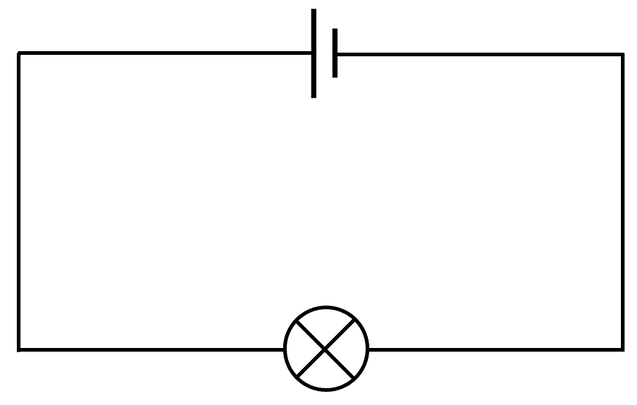
Draw on the pieces of equipment that we can use to measure the current and the potential difference for the filament bulb.
8) A filament bulb in a circuit has a potential difference across it of 1.8 V and a current of 0.4 A. Calculate the resistance of the filament bulb.
9) A light dependent resistor has a potential difference across it of 21 V and a resistance of 6 Ω. Calculate the current through the light dependent resistor.
10) Find the potential difference across an LED if the LED has a resistance of 1.4 Ω and a current of 6 A.
8) A filament bulb in a circuit has a potential difference across it of 1.8 V and a current of 0.4 A. Calculate the resistance of the filament bulb.
9) A light dependent resistor has a potential difference across it of 21 V and a resistance of 6 Ω. Calculate the current through the light dependent resistor.
10) Find the potential difference across an LED if the LED has a resistance of 1.4 Ω and a current of 6 A.